TL;DR
- About 19,100 humanoid robots were sold in the first half of 2026, almost all Chinese and mostly to factories. The home versions still need a remote human pilot.
- Even the optimistic forecast, 500,000 a year by 2030, is a rounding error next to 96 million vehicles. For most of us, a home robot is a 2030s purchase.
- The robot worth waiting for may not look like us at all. As an EPFL roboticist puts it, the dishwasher never needed shoulders.
If you grew up on cartoons, you know how this was supposed to go. It is 2026. By now a robot should be doing our chores while we are somewhere better: an interplanetary concert, say, or a weekend at the casino on the nearest meteor.
Nobody likes doing laundry. Or dishes. Or housework of any kind.
So where is our robot?
The Jetsons
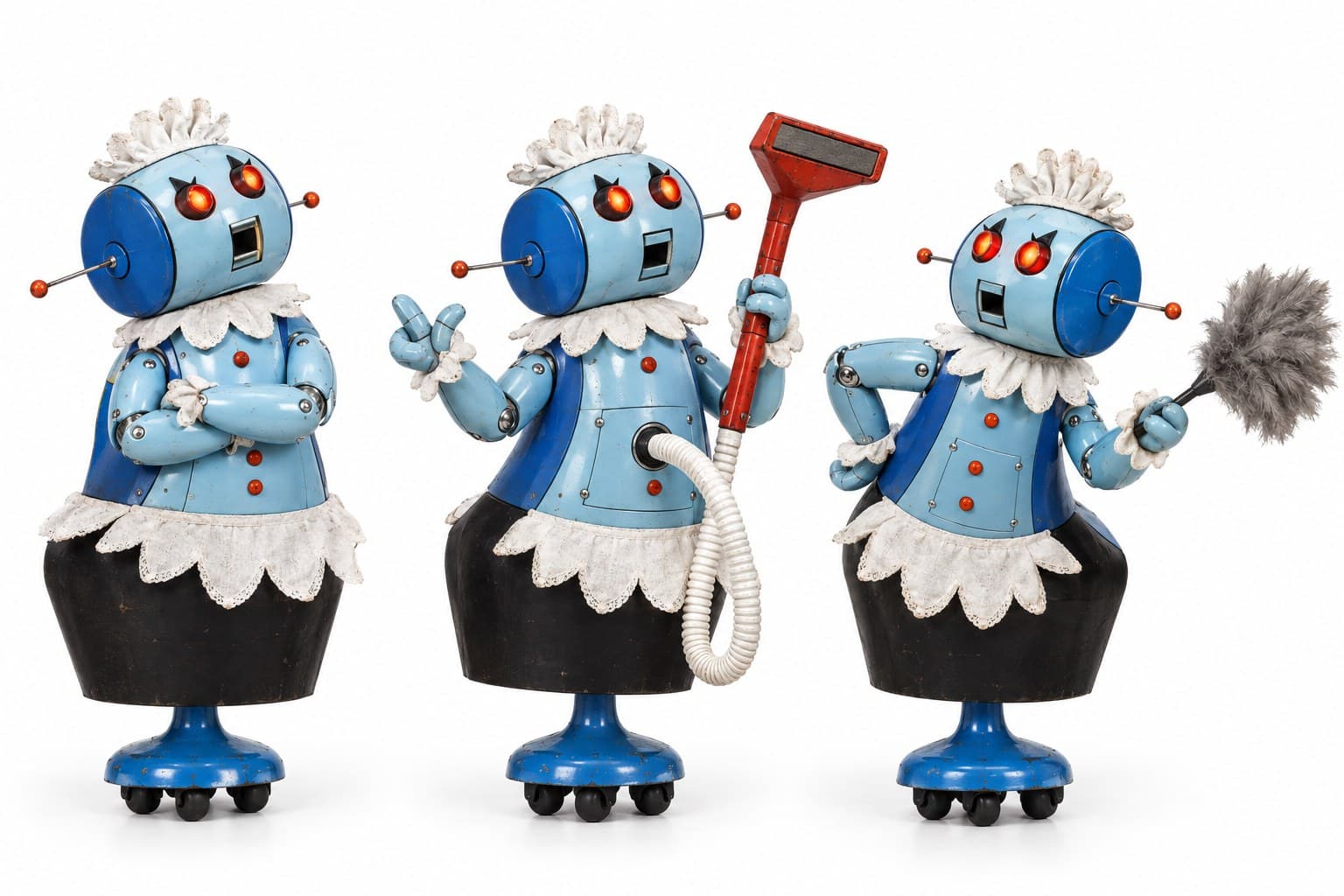
In 1962 the Jetsons got Rosey, a robot maid in an apron who cooked, cleaned and talked back. The show was set in 2062.
A year earlier, the first real robot had gone to work. Unimate stood in a General Motors plant in New Jersey, lifting hot metal parts out of a die-casting machine. It was one arm, bolted to the floor. Its inventors had met at a cocktail party, talking about Isaac Asimov.
Sixty-four years later, arms like Unimate build nearly every car in the world. Rosey is on pre-order.
Where the robots are today
Mostly at work. About 19,100 humanoid robots were sold in the first half of this year, three times as many as a year before. Seven in ten went to factories, warehouses and shops, and more than 97% were built in China, where AgiBot and Unitree lead.
The clearest picture of what one can really do comes from a car plant. Figure's robot at BMW worked ten-hour shifts for eleven months and helped build 30,000 cars, 1,250 hours of runtime in all.
Off the assembly line it gets harder, because a factory is arranged around the robot and a house is not. Google DeepMind's newest model picks an object up off the floor only 45.7% of the time in its own tests. And the promised dates are softer than they sound: Elon Musk once spoke of around 10,000 Optimus robots this year, and Tesla's line was only due to start in September.
The machines sold for the home are a different proposition: they come with a person inside. 1X will sell you its NEO for $20,000, or $499 a month. When NEO gets stuck, a 1X employee puts on a VR headset and drives it around your flat. These machines still have a long way to go, and what they do know they learned by copying people: Figure has paid people $15 million to film themselves doing chores.
The chore test
This week an AI researcher at Meta and NYU posted a screenshot of OpenAI's GPT-6 Astra under the caption "AGI is here". Underneath, Yann LeCun, who runs AMI Labs and teaches at NYU, replied with a list of chores.
He is describing the state of the art accurately. The models argue about philosophy and write working code. None of them can clear a table.
What the reply leaves out is how many people are now trying to build exactly that. The hardware got cheap: the motors, sensors, cameras and chips a robot needs were specialist kit a few years ago and are catalogue parts today, and Goldman Sachs reckons the cost of building a humanoid fell by 40% in a single year. The software stopped starting from zero: Physical Intelligence's π0 and Nvidia's GR00T already know roughly how to move a robot body, and anyone can download one and teach it their own machine. And the people who know how to do this walked out of the big labs, leaving Tesla, 1X and Figure to start companies of their own.
So cheap robots keep appearing. Nori Robotics will sell you an A3 for $1,688. Unitree's R1 starts at $4,900.
Flourish Robots came out of stealth in San Francisco the same week as LeCun's comment, with a wheeled home robot at $3,555 that you teach by showing it a chore on your phone. It lifts a kilo and a half. Among the chores the company sells it on: loading the dishwasher.
Whether a home robot needs legs at all is still argued over. Legs get you up stairs, and over the cable or the doorstep that strands a wheeled machine. Wheels cost far less and cannot fall over when the power cuts. Most of the robots actually on sale roll.
When do we get one?
Most of us, not this decade.
The forecast behind those numbers puts humanoid production at about 500,000 a year by 2030. That sounds like a lot. Then look at cars. The world built 96 million vehicles last year. If every humanoid made in 2030 came to Switzerland, one person in eighteen would get one.
The price will fall, the way it did for batteries and solar panels, because Chinese factories are already building for volume. In September XPeng opened an automated humanoid line in Guangzhou, aiming for a thousand robots a month.
Being good enough is the harder part. A robot that picks up your sock half the time is a toy. One that needs a stranger to take over is a service. To be simply yours, it has to become boring: reliable enough that nobody watches it work.
Here is our guess. The rich and curious get one now, remote pilot included. Hotels and care homes come next, because they are already paying a wage for this work, so the robot only has to cost less than the person it stands in for. The rest of us, somewhere in the 2030s, and probably not in the shape we imagined.
The dishwasher never needed shoulders
Aude Billard has spent the better part of two decades building humanoid robots at EPFL, here in Lausanne. In a recent essay in Science she asks whether loading the dishwasher is really among the most pressing problems robots should be solving, and whether a household robot needs to look and act like us at all.
Her own half-joking idea of the ultimate household robot is one with a washing machine in its belly, "politely swallowing dirty laundry", using its waste heat to warm the water and its forearms to iron. "After all," she writes, "the dishwasher never needed shoulders."
A humanoid working continuously uses three to ten times the energy of your fridge and gives off about as much heat as fifteen people. Her best detail is the lunch break: we are replacing workers who need thirty minutes in an eight-hour shift with machines whose batteries may not last half that.
The machines already do the washing. What is left is moving things around the house: carrying them to the machine, taking them out again, putting them back where they belong, and finding the sock under the sofa. Some of that will arrive built into the appliances, without anyone calling it a robot.
What it will mean for us
Probably less free time than you think. When washing machines and vacuum cleaners arrived, we did not get those hours back. The standard for "clean" went up instead, which is why the historian Ruth Schwartz Cowan called her book about it More Work for Mother. So you will probably end up with a tidier flat and much the same Saturday.
Then there is the question of who really owns it. If you pay by the month for a robot that has learned the layout of your home and is sometimes driven by someone at the company, you are renting, and the company can change the deal whenever it likes. Cory Doctorow has a name for what happens to services once people depend on them: enshittification. Prices rise, the good features move behind another subscription, and what you liked quietly stops working the way it did. Only this one has arms, and it knows which drawer you keep the cutlery in.
So Rosey was never the right thing to wait for. The robot that actually helps may not look like a person at all: more likely a kitchen that empties itself, or something on wheels that carries the shoes back upstairs. And if one does move in, the questions that matter are about the company behind it. Who else can see what its cameras see, and what stops working the day you stop paying.
The Jetsons set their story in 2062. Will we need most of that time?